
Nintendo – 86th Annual General Meeting of Shareholders: approval ratings, CSR report, message from the President, Q&A
On June 26th, Nintendo held its 85th Annual General Meeting of Shareholders. It took place at 10AM JST at the Kyoto International Exhibition Hall “Miyako Messe” (Exhibition Hall 3, Floor 3), instead of Nintendo’s headquarters.
Shareholders were invited to vote on several matters:
- the distribution of surplus
- the Election of Nine Directors (excluding Directors Who Are Audit and Supervisory Committee Members)
- the Election of Four Directors Who Are Audit and Supervisory Committee Members
- the Revision of the Amount of Compensation to Grant Restricted Stock to Directors (Excluding Directors Who Are Audit and Supervisory Committee Members and Outside Directors)
Proposal 1: distribution of surplus
The company proposed a dividend of 177 yen per share of common stock for a total of 204,050,680,785 yen. Including the interim dividend (42 Yen), that’s 219 yen per share (up from 120 Yen the previous year).
Results of the vote: the proposal was approved. Approval: 8,702,626 votes (97.80%). Against: 129,013. Abstentions: 7,351.
Proposal 2 Election of Nine Directors (excluding Directors who are Audit and Supervisory Committee Members)
The company proposed that the following Directors be elected or re-elected:
- Shuntaro Furukawa (re-election)
- Shigeru Miyamoto (re-election)
- Shinya Takahashi (re-election)
- Satoru Shibata (re-election)
- Ko Shiota (re-election)
- Yusuke Beppu (election)
- Chris Meledandri (re-election)
- Miyoko Demay (re-election)
- Kazuhiko Hachiya (re-election)
Results of the vote: all Directors were elected/re-elected. Here’s their approval ratings:
- Shuntaro Furukawa: 8,096,208 votes in favour (90.98%), 705,775 votes against, 37,014 abstentions
- Shigeru Miyamoto: 8,525,124 votes in favour (95.80%), 246,668 votes against, 67,216 abstentions
- Shinya Takahashi: 8,557,442 votes in favour (96.17%), 214,350 votes against, 67,216 abstentions
- Satoru Shibata: 8,557,470 votes in favour (96.17%), 214,322 votes against, 67,216 abstentions
- Ko Shiota: 8,557,529 votes in favour (96.17%), 214,263 votes against, 67,216 abstentions
- Yusuke Beppu: 8,558,824 votes in favour (96.18%), 212,968 votes against, 67,216 abstentions
- Chris Meledandri: 6,678,895 votes in favour (75.06%), 2,151,141 votes against, 8,974 abstentions
- Miyoko Demay: 8,741,938 votes in favour (98.24%), 88,227 votes against, 8,853 abstentions
- Kazuhiko Hachiya: 8,734,020 votes in favour, 96,024 votes against, 8,974 abstentions
As comparison, their approval ratings last year were as follows:
- Shuntaro Furukawa: 8,743,745 votes in favour (92.60%), 571,217 votes against, 52,093 abstentions
- Shigeru Miyamoto: 9,082,442 votes in favour (96.18%), 231,206 votes against, 53,414 abstentions
- Shinya Takahashi: 9,086,983 votes in favour (96.23%), 226,665 votes against, 53,414 abstentions
- Satoru Shibata: 9,086,934 votes in favour (96.23%), 226,714 votes against, 53,414 abstentions
- Ko Shiota: 9,086,999 votes in favour (96.23%), 226,649 votes against, 53,414 abstentions
- Yusuke Beppu: 9,086,849 votes in favour (96.23%), 226,799 votes against, 53,414 abstentions
- Chris Meledandri: 7,164,790 votes in favour (75.87%), 2,189,091 votes against, 13,182 abstentions
- Miyoko Demay: 9,248,456 votes in favour (97.94%), 105,551 votes against, 13,057 abstentions
- Kazuhiko Hachiya: 9,264,069 votes in favour (98.11%), 89,814 votes against, 13,182 abstentions
Proposal 3: the Election of Four Directors Who Are Audit and Supervisory Committee Members
The company proposed that the following Directors be elected or re-elected:
- Yutaka Takenaga (election)
- Asa Shinkawa (re-election)
- Eiko Osawa (re-election)
- Chika Saka (election)
Results of the vote: all Directors were elected/re-elected. Their approval ratings is as follows:
- Yutaka Takenaga: 8,224,008 votes in favour (92.42%), 606,005 votes against, 8,977 abstentions
- Asa Shinkawa: 8,737,475 votes in favour (98.19%), 92,671 votes against, 8,856 abstentions
- Eiko Osawa: 8,736,613 votes in favour (98.18%), 93,533 votes against, 8,856 abstentions
- Chika Saka: 8,750,216 votes in favour (98.33%), 79,932 votes against, 8,856 abstentions
Proposal 4: the Revision of the Amount of Compensation to Grant Restricted Stock to Directors (Excluding Directors Who Are Audit and Supervisory Committee Members and Outside Directors)
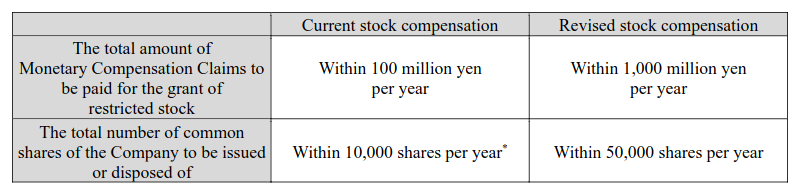
Compensation for Directors (excluding Directors who are Audit and Supervisory Committee Members and Outside Directors; hereinafter referred to as “Eligible Directors”) is composed of fixed compensation, performance-based compensation, and stock compensation. Regarding the stock compensation, grant of restricted stock to Eligible Directors was approved at the 82nd Annual General Meeting of Shareholders on June 29, 2022, with the amount presented below under “Current stock compensation” as the upper limit, separate from the fixed compensation and performance-based compensation.
Now, to provide an incentive to achieve the sustainable increase of the Company’s corporate value and further promote value sharing with shareholders, the Company proposes revising the upper limit of the total amount of monetary compensation claims granted for the delivery of restricted stock and the upper limit of the total number of common shares of the Company to be issued or disposed of as shown in “Revised stock compensation” below.
Results of the vote: the proposal was approved. The results: 8,574,619 votes in favour (96.36%), 242,155 votes against, 22,249 abstentions.
Next, Nintendo updated its CSR Report. You will find it on these pages:
The new message from the president (Shuntaro Furukawa) also be shared:
Guided by our sustainability goal of “putting smiles on the faces of everyone Nintendo touches,” we continually explore how Nintendo can best fulfill its social responsibilities through group-wide collaboration.
Taking into account the social conditions surrounding Nintendo, we have set four sustainability priorities: “consumers,” “supply chain,” “employees” and “environment.” We continue to conduct our sustainability activities based on this framework.
These four priorities encompass initiatives that include improving product quality and ensuring product safety; creating an environment in which consumers can play with peace of mind; promoting CSR procurement through communication with our suppliers; building a work environment that enables our employees to fully realize their capabilities; and reducing the environmental impact of our products and business activities. We will continue these efforts, while appropriately disclosing the status of our sustainability activities, in alignment with our four priorities.
Nintendo remains dedicated to thoroughly refining each product and service to ensure satisfaction. By working to help foster an enduring fondness for Nintendo IP, we hope to become a beloved part of people’s lives across generations. Through our sustainability activities, we will further our efforts to build trust with all our stakeholders, including our consumers, and create more reasons to choose Nintendo for unique, family-friendly entertainment.
Finally, there’s the usual Q&A session with investors. The full transcript is now available in English click here to check it out!
Here’s the list of questions:
Question 1: With the release of Splatoon Raiders approaching, how does Nintendo evaluate the previous title, Splatoon 3? Some players experienced communication errors and discrepancies in hit detection in that title. I feel that Nintendo’s response to these issues may not have been consistent with “sincerity,” one of the values in the Nintendo DNA.
Question 2: As the number of employees increases, how will Nintendo cultivate talent and pass on Nintendo’s approach to product creation, including the Nintendo DNA?
Question 3: How does Nintendo share profits with its employees?
Question 4: Are there any plans to make Nintendo DS or Nintendo 3DS software playable on Nintendo Switch 2?
Question 5: How does Nintendo view recording, preserving, and passing on Nintendo’s culture and philosophy of play through books, Nintendo Museum, and other means, and archiving them for the future?
Question 6: There are cases where indie games for PC become popular, but it takes time before they are released for Nintendo Switch. What initiatives is Nintendo undertaking to shorten the porting timeline and encourage indie developers to choose Nintendo platforms earlier in the process?
Question 7: How does Nintendo view increasing points of contact with Nintendo IP through videos and other non-game content for children who are not yet old enough to play games on their own, or for households that do not usually play games?
Question 8: How does Nintendo assess the Indian market over the mid-to-long term? When developing the business there, what points will you emphasize?
Question 9: In China, how will Nintendo promote the use of Nintendo IP through IP licensing and other businesses that do not depend on the spread of the dedicated video game platform?
Question 10: What is your view on Nintendo’s current share price? Also, does Nintendo have any plans to introduce a shareholder benefit program?
Question 11: How does Nintendo position forms of play that make use of features unique to smart devices, such as Pictonico!, and what developments are you considering going forward?
Question 12: In the development of Rhythm Heaven Groove, how did Nintendo position accessibility, and how did the development team approach it? Also, how will Nintendo apply the knowledge gained from that process to future titles?
Question 13: With developments such as the establishment of AI-related laws in the EU, how does Nintendo view and respond to the use of generative AI trained without permission from rights holders, and to the risk of intellectual property infringement caused by generative AI?
Question 14: Regarding the basic strategy of ”expanding the number of people who have access to Nintendo IP,” how does Nintendo look back on the initiatives it has undertaken so far, and how will you develop this strategy going forward?
Question 15: In the Pokémon Trading Card Game, there have been cases of bulk purchasing and high-priced reselling. In terms of creating an environment where consumers can purchase and enjoy the products with peace of mind, how does Nintendo view this issue, and is Nintendo working with The Pokémon Company to address it?
Question 16: In Proposal No. 4 at this General Meeting of Shareholders, Nintendo has proposed increasing the upper limit for stock compensation for Directors. Please explain the rationale for this increase and the criteria used to determine the amount.
Question 17: Please tell us why Executive Officer Tezuka is concluding his term, and how he will be involved with Nintendo going forward. I would also like to hear a few words from him.
Question 18: When Nintendo Direct is streamed on external platforms such as YouTube, there would seem to be risks such as information being leaked in advance. Does Nintendo have any plans to create its own means for delivering information directly to consumers?
Question 19: What impact will rising memory prices have on Nintendo Switch 2 production and profitability, and how will Nintendo respond going forward?
